Liheng Chen
 MSc in Advanced Computer Science (ACS)
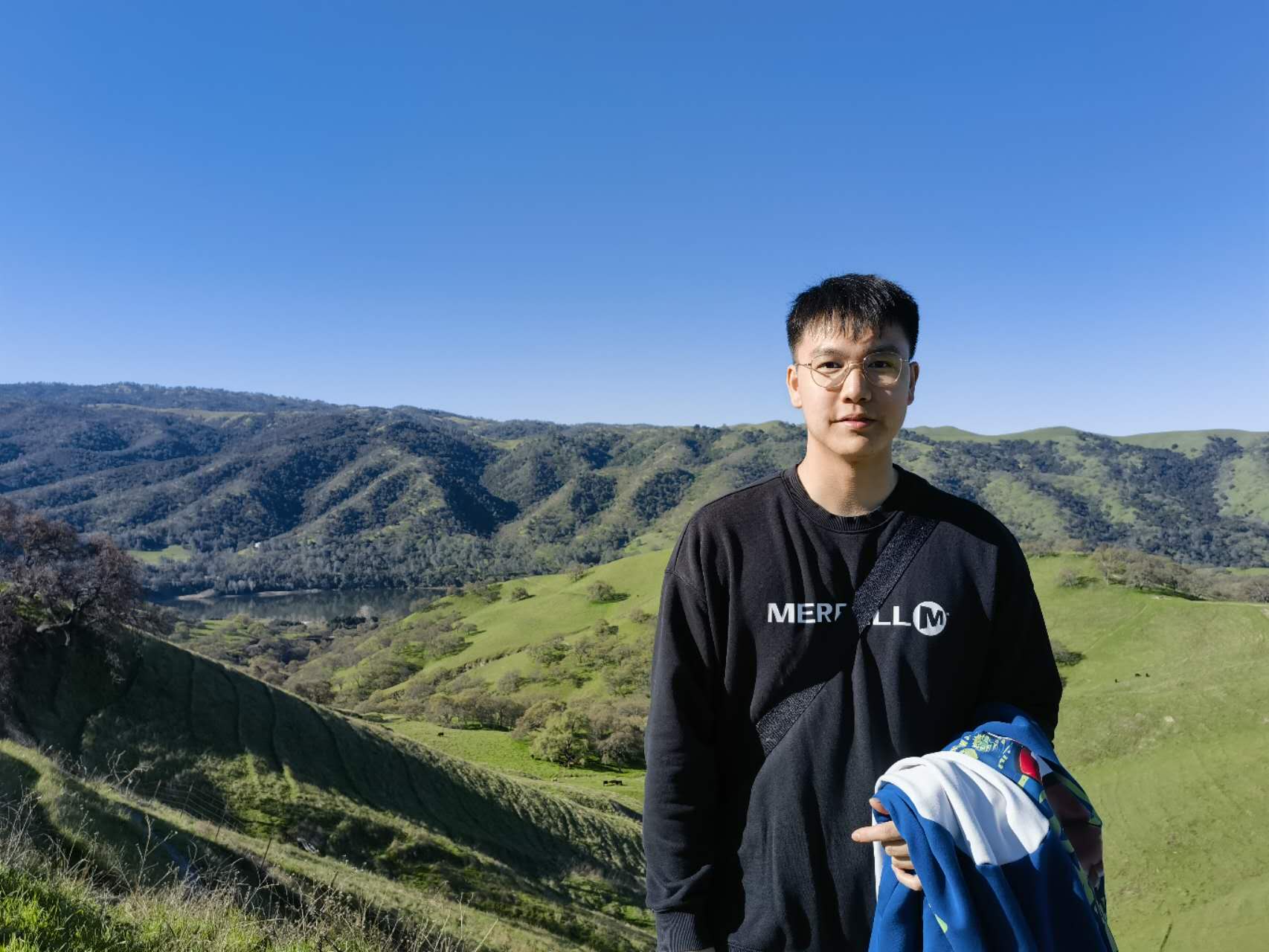
I am a master student at the University of Oxford (Reuben College). Previously, I was an undergraduate student researcher from the University of Hong Kong (HKU). My research interests include Agentic LLMs, Parameter-Efficient Fine-Tuning (PEFT) and conditional non-autoregressive text generation. I am also interseted in 📷photography and ⛰️hiking.
Love is the one thing we're capable of perceiving that transcends dimensions of time and space
Action required
Problem: The current root path of this site is "baseurl ("_config.yml.
Solution: Please set the
baseurl in _config.yml to "🎓 Education
-
University of OxfordMSc in Advanced Computer Science (Artificial Intelligence)Oct. 2025 - Nov. 2026
-
 University of California, BerkeleyVisiting StudentJan. 2024 - May. 2024
 -
 University of Hong KongBEng in Computer Science (First Class Honors)Sep. 2021 - Jun. 2025
🔬 Experience
-
 Eigent AI, LondonAI EngineerJul. 2026 - Present
 -
 Torr Vision Group, University of OxfordStudent ResearcherOct. 2025 - Jul. 2026
 -
NLP Group, University of Hong KongResearch AssistantJul. 2022 - Oct. 2025
🎊 Honors & Awards
-
Teaching Development and Language Enhancement Grant (TDLEG)2024
-
HKU Reaching Out Award (ROA) Exchange Scholarship2024
-
Dean's Honors List, Department of Computer Science, HKU2022
-
China Soong Ching Ling Foundation Zhiyuan Bursary Recipient2021
News
Selected Publications (view all )
OSReward: Instituting Standardized Evaluation for Cross-Platform Computer-Use Reward Models
Qiushi Sun*, Kanzhi Cheng*, Yian Wang*, Bowen Yang*, Hang Yan*, Liheng Chen*, Fangzhi Xu, Zichen Ding, Nuo Chen, Jialin Cao, Xingdong Gong, Zehao Li, Kaiming Jin, Xinfeng Yuan, Zhoumianze Liu, Jingyang Gong, Zhangyue Yin, Jiahui Gao, Zhiyong Wu, Tianbao Xie, Jianbing Zhang, Ben Kao, Lingpeng Kong (* equal contribution)
Preprint 2026 Arxiv
Computer-using agents (CUAs) are advancing rapidly across the digital world. A CUA trajectory records the agent's actions, states, and reasoning. Verifying whether it fulfilled the task instruction is central to CUA evaluation, data curation, and reinforcement learning. Neither human-written verifiers nor human annotators can provide such verification at scale, so the field increasingly turns to vision-language models (VLMs) as judges of CUA trajectories. But a fundamental question has long gone unexamined: are these VLM judges reliable enough? To study it systematically, we introduce OSReward, a realistic, high-quality benchmark that evaluates VLM judges on CUA trajectories. The trajectories come from diverse agent backbones executing human-verified instructions across platforms, and are then rigorously labeled with ground-truth verdicts through multi-stage human annotation. Building on it, we derive OSReward-Hard, a challenge set concentrating genuinely hard cases, and OSReward-Multi for fine-grained efficiency and alignment scoring. The most comprehensive evaluation of VLM judges to date finds even state-of-the-art models fall short of an ideal judge, sharing a systematic leniency bias that mislabels failed runs as successes. The few reliable enough to trust are too expensive to run at scale, while affordable open models trail far behind. To close this gap, we construct and release OS-Shepherd-100K, an open corpus of reasoning-annotated trajectory judgments for the CUA community. On it, we train OS-Shepherd (9B and 35B), open reward models that supply low-cost, stable, and reliable reward signals, matching commercial judges at 30-60x lower cost than the frontier. Extensive analyses further inform the design of reliable CUA reward at scale.


OSReward: Instituting Standardized Evaluation for Cross-Platform Computer-Use Reward Models
Qiushi Sun*, Kanzhi Cheng*, Yian Wang*, Bowen Yang*, Hang Yan*, Liheng Chen*, Fangzhi Xu, Zichen Ding, Nuo Chen, Jialin Cao, Xingdong Gong, Zehao Li, Kaiming Jin, Xinfeng Yuan, Zhoumianze Liu, Jingyang Gong, Zhangyue Yin, Jiahui Gao, Zhiyong Wu, Tianbao Xie, Jianbing Zhang, Ben Kao, Lingpeng Kong (* equal contribution)
Preprint 2026 Arxiv
Computer-using agents (CUAs) are advancing rapidly across the digital world. A CUA trajectory records the agent's actions, states, and reasoning. Verifying whether it fulfilled the task instruction is central to CUA evaluation, data curation, and reinforcement learning. Neither human-written verifiers nor human annotators can provide such verification at scale, so the field increasingly turns to vision-language models (VLMs) as judges of CUA trajectories. But a fundamental question has long gone unexamined: are these VLM judges reliable enough? To study it systematically, we introduce OSReward, a realistic, high-quality benchmark that evaluates VLM judges on CUA trajectories. The trajectories come from diverse agent backbones executing human-verified instructions across platforms, and are then rigorously labeled with ground-truth verdicts through multi-stage human annotation. Building on it, we derive OSReward-Hard, a challenge set concentrating genuinely hard cases, and OSReward-Multi for fine-grained efficiency and alignment scoring. The most comprehensive evaluation of VLM judges to date finds even state-of-the-art models fall short of an ideal judge, sharing a systematic leniency bias that mislabels failed runs as successes. The few reliable enough to trust are too expensive to run at scale, while affordable open models trail far behind. To close this gap, we construct and release OS-Shepherd-100K, an open corpus of reasoning-annotated trajectory judgments for the CUA community. On it, we train OS-Shepherd (9B and 35B), open reward models that supply low-cost, stable, and reliable reward signals, matching commercial judges at 30-60x lower cost than the frontier. Extensive analyses further inform the design of reliable CUA reward at scale.
OS-Genesis: Automating GUI Agent Trajectory Construction via Reverse Task Synthesis
Qiushi Sun*, Kanzhi Cheng*, Zichen Ding*, Chuanyang Jin*, Yian Wang, Fangzhi Xu, Zhenyu Wu, Liheng Chen, Chengyou Jia, Zhoumianze Liu, Ben Kao, Guohao Li, Junxian He, Yu Qiao, Zhiyong Wu (* equal contribution)
Annual Meeting of the Association for Computational Linguistics 2025 ACL 2025
Graphical User Interface (GUI) agents powered by Vision-Language Models (VLMs) have demonstrated human-like computer control capability. Despite their utility in advancing digital automation, a critical bottleneck persists: collecting high-quality trajectory data for training. Common practices for collecting such data rely on human supervision or synthetic data generation through executing pre-defined tasks, which are either resource-intensive or unable to guarantee data quality. Moreover, these methods suffer from limited data diversity and significant gaps between synthetic data and real-world environments. To address these challenges, we propose OS-Genesis, a novel GUI data synthesis pipeline that reverses the conventional trajectory collection process. Instead of relying on pre-defined tasks, OS-Genesis enables agents first to perceive environments and perform step-wise interactions, then retrospectively derive high-quality tasks to enable trajectory-level exploration. A trajectory reward model is then employed to ensure the quality of the generated trajectories. We demonstrate that training GUI agents with OS-Genesis significantly improves their performance on highly challenging online benchmarks. In-depth analysis further validates OS-Genesis's efficiency and its superior data quality and diversity compared to existing synthesis methods.

OS-Genesis: Automating GUI Agent Trajectory Construction via Reverse Task Synthesis
Qiushi Sun*, Kanzhi Cheng*, Zichen Ding*, Chuanyang Jin*, Yian Wang, Fangzhi Xu, Zhenyu Wu, Liheng Chen, Chengyou Jia, Zhoumianze Liu, Ben Kao, Guohao Li, Junxian He, Yu Qiao, Zhiyong Wu (* equal contribution)
Annual Meeting of the Association for Computational Linguistics 2025 ACL 2025
Graphical User Interface (GUI) agents powered by Vision-Language Models (VLMs) have demonstrated human-like computer control capability. Despite their utility in advancing digital automation, a critical bottleneck persists: collecting high-quality trajectory data for training. Common practices for collecting such data rely on human supervision or synthetic data generation through executing pre-defined tasks, which are either resource-intensive or unable to guarantee data quality. Moreover, these methods suffer from limited data diversity and significant gaps between synthetic data and real-world environments. To address these challenges, we propose OS-Genesis, a novel GUI data synthesis pipeline that reverses the conventional trajectory collection process. Instead of relying on pre-defined tasks, OS-Genesis enables agents first to perceive environments and perform step-wise interactions, then retrospectively derive high-quality tasks to enable trajectory-level exploration. A trajectory reward model is then employed to ensure the quality of the generated trajectories. We demonstrate that training GUI agents with OS-Genesis significantly improves their performance on highly challenging online benchmarks. In-depth analysis further validates OS-Genesis's efficiency and its superior data quality and diversity compared to existing synthesis methods.
OS-ATLAS: A Foundation Action Model for Generalist GUI Agents
Zhiyong Wu*, Zhenyu Wu*, Fangzhi Xu*, Yian Wang*, Qiushi Sun, Chengyou Jia, Kanzhi Cheng, Zichen Ding, Liheng Chen, Paul Pu Liang, Yu Qiao (* equal contribution)
International Conference on Learning Representations 2025 ICLR 2025 Spotlight
Existing efforts in building GUI agents heavily rely on the availability of robust commercial Vision-Language Models (VLMs) such as GPT-4o and GeminiProVision. Practitioners are often reluctant to use open-source VLMs due to their significant performance lag compared to their closed-source counterparts, particularly in GUI grounding and Out-Of-Distribution (OOD) scenarios. To facilitate future research in this area, we developed OS-Atlas —a foundational GUI action model that excels at GUI grounding and OOD agentic tasks through innovations in both data and modeling. We have invested significant engineering effort in developing an open-source toolkit for synthesizing GUI grounding data across multiple platforms, including Windows, Linux, MacOS, Android, and the web. Leveraging this toolkit, we are releasing the largest open-source cross-platform GUI grounding corpus to date, which contains over 13 million GUI elements. This dataset, combined with innovations in model training, provides a solid foundation for OS-Atlas to understand GUI screenshots and generalize to unseen interfaces. Through extensive evaluation across six benchmarks spanning three different platforms (mobile, desktop, and web), OS-Atlas demonstrates significant performance improvements over previous state-of-the-art models. Our evaluation also uncovers valuable insights into continuously improving and scaling the agentic capabilities of open-source VLMs.

OS-ATLAS: A Foundation Action Model for Generalist GUI Agents
Zhiyong Wu*, Zhenyu Wu*, Fangzhi Xu*, Yian Wang*, Qiushi Sun, Chengyou Jia, Kanzhi Cheng, Zichen Ding, Liheng Chen, Paul Pu Liang, Yu Qiao (* equal contribution)
International Conference on Learning Representations 2025 ICLR 2025 Spotlight
Existing efforts in building GUI agents heavily rely on the availability of robust commercial Vision-Language Models (VLMs) such as GPT-4o and GeminiProVision. Practitioners are often reluctant to use open-source VLMs due to their significant performance lag compared to their closed-source counterparts, particularly in GUI grounding and Out-Of-Distribution (OOD) scenarios. To facilitate future research in this area, we developed OS-Atlas —a foundational GUI action model that excels at GUI grounding and OOD agentic tasks through innovations in both data and modeling. We have invested significant engineering effort in developing an open-source toolkit for synthesizing GUI grounding data across multiple platforms, including Windows, Linux, MacOS, Android, and the web. Leveraging this toolkit, we are releasing the largest open-source cross-platform GUI grounding corpus to date, which contains over 13 million GUI elements. This dataset, combined with innovations in model training, provides a solid foundation for OS-Atlas to understand GUI screenshots and generalize to unseen interfaces. Through extensive evaluation across six benchmarks spanning three different platforms (mobile, desktop, and web), OS-Atlas demonstrates significant performance improvements over previous state-of-the-art models. Our evaluation also uncovers valuable insights into continuously improving and scaling the agentic capabilities of open-source VLMs.
MoS: Unleashing Parameter Efficiency of Low-Rank Adaptation with Mixture of Shards
Sheng Wang*, Liheng Chen*, Pengan Chen, Jingwei Dong, Boyang Xue, Jiyue Jiang, Lingpeng Kong, Chuan Wu (* equal contribution)
International Conference on Learning Representations 2025 ICLR 2025
The rapid scaling of large language models necessitates more lightweight finetuning methods to reduce the explosive GPU memory overhead when numerous customized models are served simultaneously. Targeting more parameter-efficient low-rank adaptation (LoRA), parameter sharing presents a promising solution. Empirically, our research into high-level sharing principles highlights the indispensable role of differentiation in reversing the detrimental effects of pure sharing. Guided by this finding, we propose Mixture of Shards (MoS), incorporating both inter-layer and intra-layer sharing schemes, and integrating four nearly cost-free differentiation strategies, namely subset selection, pair dissociation, vector sharding, and shard privatization. Briefly, it selects a designated number of shards from global pools with a Mixture-of-Experts (MoE)-like routing mechanism before sequentially concatenating them to low-rank matrices. Hence, it retains all the advantages of LoRA while offering enhanced parameter efficiency, and effectively circumvents the drawbacks of peer parameter-sharing methods. Our empirical experiments demonstrate approximately 8x parameter savings in a standard LoRA setting. The ablation study confirms the significance of each component. Our insights into parameter sharing and MoS method may illuminate future developments of more parameter-efficient finetuning methods.
Diffusion of Thought: Chain-of-Thought Reasoning in Diffusion Language Models
Jiacheng Ye*, Shansan Gong*, Liheng Chen*, Lin Zheng, Jiahui Gao, Han Shi, Chuan Wu, Xin Jiang, Zhenguo Li, Wei Bi, Lingpeng Kong (* equal contribution)
Annual Conference on Neural Information Processing System 2024 NeurIPS 2024
Recently, diffusion models have garnered significant interest in the field of text processing due to their many potential advantages compared to conventional autoregressive models. In this work, we propose Diffusion-of-Thought (DoT), a novel approach that integrates diffusion models with Chain-of-Thought, a well-established technique for improving the reasoning ability of autoregressive language models. In contrast to autoregressive language models that make decisions in a left-to-right, token-by-token manner, DoT allows reasoning steps to diffuse over time through a diffusion language model and offers greater flexibility in trading-off computation for reasoning performance. Our experimental results demonstrate the effectiveness of DoT in multi-digit multiplication, boolean logic, and grade school math problems, with a small diffusion model outperforming a much larger autoregressive model in both efficiency and accuracy. In addition to that, DoT showcases promising self-correction abilities and benefits from existing reasoning-enhancing techniques like self-consistency decoding. Our findings contribute to the understanding and development of reasoning with diffusion language models.

Diffusion of Thought: Chain-of-Thought Reasoning in Diffusion Language Models
Jiacheng Ye*, Shansan Gong*, Liheng Chen*, Lin Zheng, Jiahui Gao, Han Shi, Chuan Wu, Xin Jiang, Zhenguo Li, Wei Bi, Lingpeng Kong (* equal contribution)
Annual Conference on Neural Information Processing System 2024 NeurIPS 2024
Recently, diffusion models have garnered significant interest in the field of text processing due to their many potential advantages compared to conventional autoregressive models. In this work, we propose Diffusion-of-Thought (DoT), a novel approach that integrates diffusion models with Chain-of-Thought, a well-established technique for improving the reasoning ability of autoregressive language models. In contrast to autoregressive language models that make decisions in a left-to-right, token-by-token manner, DoT allows reasoning steps to diffuse over time through a diffusion language model and offers greater flexibility in trading-off computation for reasoning performance. Our experimental results demonstrate the effectiveness of DoT in multi-digit multiplication, boolean logic, and grade school math problems, with a small diffusion model outperforming a much larger autoregressive model in both efficiency and accuracy. In addition to that, DoT showcases promising self-correction abilities and benefits from existing reasoning-enhancing techniques like self-consistency decoding. Our findings contribute to the understanding and development of reasoning with diffusion language models.
LoRA Meets Dropout under a Unified Framework
Sheng Wang*, Liheng Chen*, Jiyue Jiang, Boyang Xue, Lingpeng Kong, Chuan Wu (* equal contribution)
Annual Meeting of the Association for Computational Linguistics 2024 ACL 2024
With the remarkable capabilities, large language models (LLMs) have emerged as essential elements in numerous NLP applications, while parameter-efficient finetuning, especially LoRA, has gained popularity as a lightweight approach for model customization. Meanwhile, various dropout methods, initially designed for full finetuning with all the parameters updated, alleviates overfitting associated with excessive parameter redundancy. Hence, a possible contradiction arises from negligible trainable parameters of LoRA and the effectiveness of previous dropout methods, which has been largely overlooked. To fill this gap, we first confirm that parameter-efficient LoRA is also overfitting-prone. We then revisit transformerspecific dropout methods, and establish their equivalence and distinctions mathematically and empirically. Building upon this comparative analysis, we introduce a unified framework for a comprehensive investigation, which instantiates these methods based on dropping position, structural pattern and compensation measure. Through this framework, we reveal the new preferences and performance comparisons of them when involved with limited trainable parameters. This framework also allows us to amalgamate the most favorable aspects into a novel dropout method named HiddenKey. Extensive experiments verify the remarkable superiority and sufficiency of HiddenKey across multiple models and tasks, which highlights it as the preferred approach for high-performance and parameter-efficient finetuning of LLMs.